
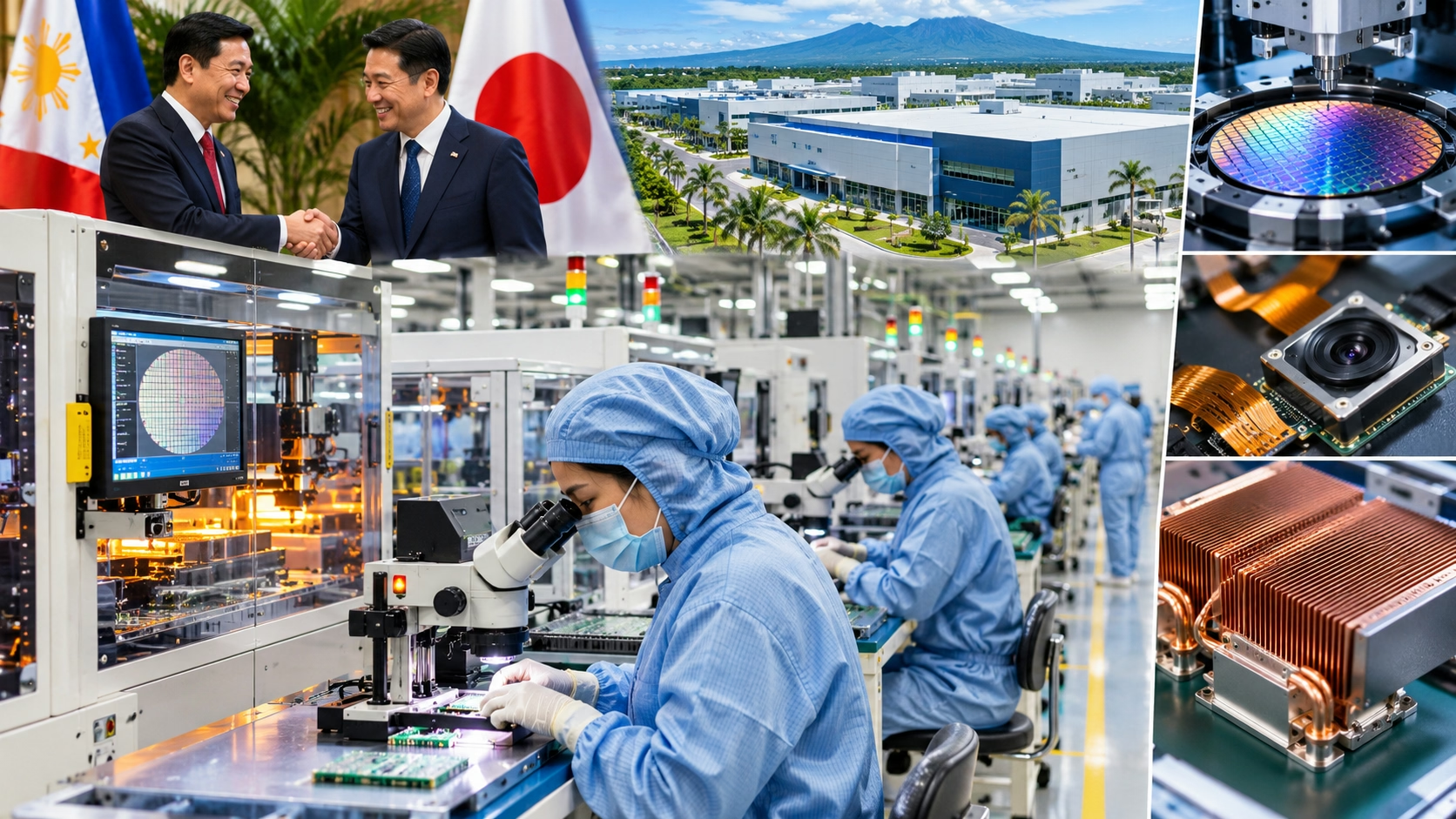
When Trade Undersecretary Ceferino Rodolfo signed the Pax Silica declaration in April 2026, the Philippines became the 13th signatory of a US-led coalition to secure semiconductor, critical mineral, and AI supply chains. At the center of the arrangement is a proposed 1,620-hectare Economic Security Zone in New Clark City, Tarlac—a tract of land intended to host advanced manufacturing, semiconductor packaging, and critical-mineral processing for allied supply chains.
The Geopolitical Opening Is Real
The strategic logic is straightforward. The Philippines is a US treaty ally, has a 50-year history in semiconductor assembly, testing, and packaging, and exported a record $84.5 billion in electronics in the previous year. It is also the world’s second-largest nickel producer, with copper and cobalt reserves that appear on the US critical-minerals list. For Washington, the Philippines offers geographic distance from Taiwan Strait flashpoints and a legal environment that is more predictable than some alternative jurisdictions.
The zone is not purely symbolic. The US International Development Finance Corporation has approved a $1.5 billion energy platform, the Millennium Challenge Corporation signed a $60 million energy-governance program, and PEZA approvals rose 94% in the first half of 2026, led by electronics. Those are tangible commitments, not just memoranda of understanding.
The Infrastructure Math Is Sobering
The constraints, however, are physical. BCDA’s projected power need for the zone has risen from 3 gigawatts to at least 5 gigawatts—far beyond the proposed $200 million solar project that has been discussed as an anchor supply source. A 3-gigawatt requirement would represent roughly 16% of the current Luzon grid capacity, and the zone’s projected water demand for AI data-center cooling and mineral processing is estimated at 130 million liters per day, exceeding local reservoir capacity.
These are not teething problems. They are the core determinants of whether the zone can host energy-intensive advanced manufacturing. The Philippines already has some of the highest industrial electricity rates in the region, and adding 5 gigawatts of new load without equally aggressive generation and transmission investment would put upward pressure on prices for existing users.
Contractual Certainty Is Still Pending
For manufacturers accustomed to long-lived capital investments, the zone’s legal framework matters as much as its power supply. The master lease for the 1,620-hectare site is targeted before the end of 2026, and until it is signed, locator terms remain unavailable. Foxconn has been announced as a participant but not contracted, and much of the $20 billion deal book represents potential rather than committed capital—21 of 38 listed projects lack cost estimates.
That uncertainty is normal for a first-of-its-kind industrial diplomacy project, but it complicates board-level decisions. A semiconductor packaging company evaluating New Clark City cannot underwrite a facility on the basis of a declaration; it needs a lease, a power purchase agreement, and a customs regime that is operational, not aspirational.
The Strategic Bet Behind the Zone
The deeper bet is that the Philippines can use security alignment to escape the low-value end of manufacturing. The OECD’s 2026 survey is blunt about why the country has lagged: industrial electricity at nearly 15 cents per kilowatt-hour, roughly 50% above Indonesia and Vietnam, and logistics costs eating about a quarter of sales. Tax holidays cannot fix those structural penalties. What Pax Silica offers is not a subsidy for inefficiency but a demand anchor—a set of allied buyers and investors willing to pay a security premium for supply-chain diversification.
Whether that premium is large enough to overcome the power and logistics gaps is the unanswered question of 2026. The zone’s first signed lease will be a more meaningful signal than any declaration.