
55 Endangered Languages and a Closing Window
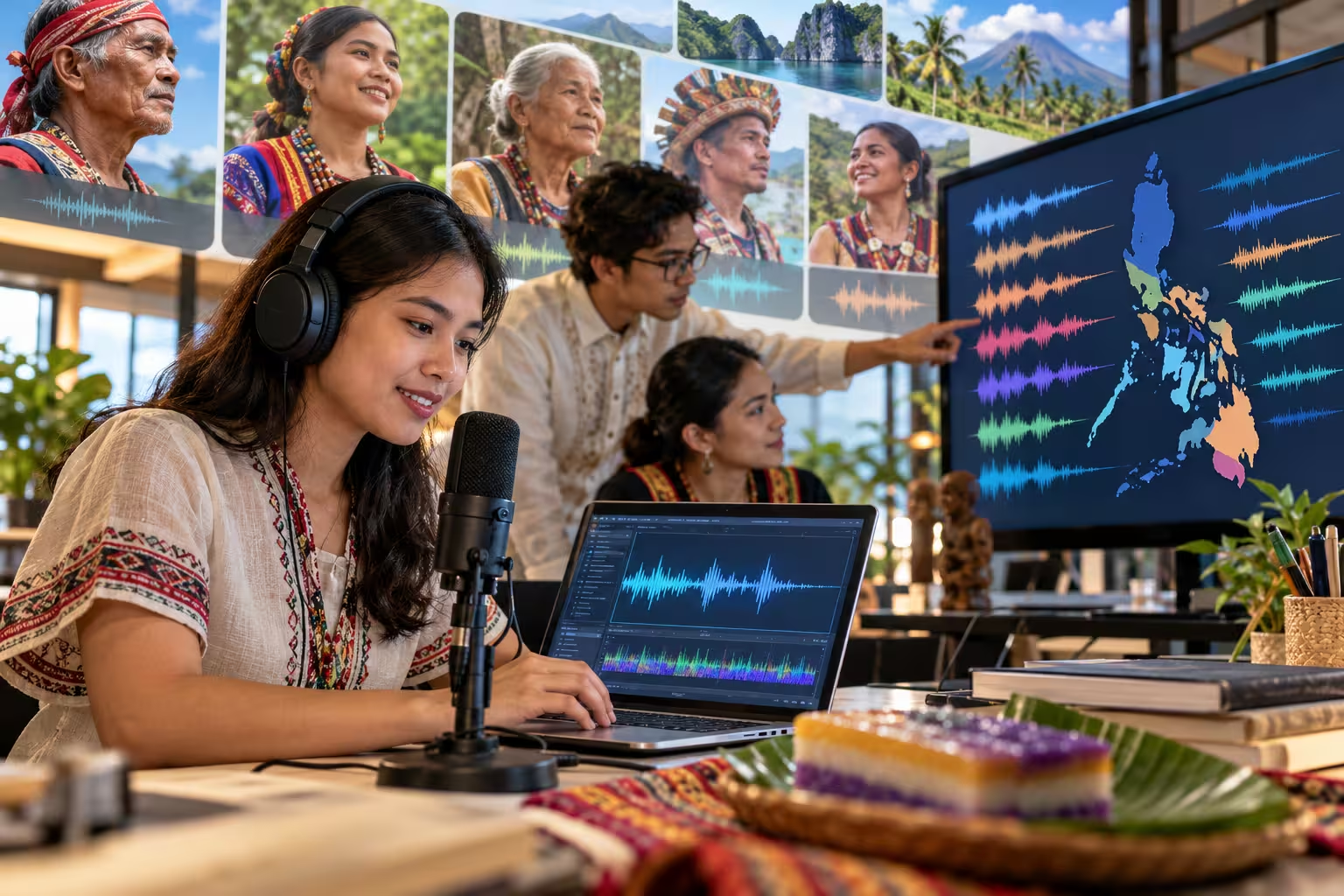
Of the 175 indigenous languages currently used in the Philippines, roughly 55 are considered endangered according to the most recent Ethnologue assessment. For Atty. Anna Mae Yu Lamentillo, a Karay-a from the Philippines and former Undersecretary at the Department of Information and Communications Technology, that statistic is not an abstraction. It is a deadline.
Lamentillo is the founder of NightOwl AI, a company incubated under LSE Generate at the London School of Economics. The startup uses machine learning to help preserve endangered, low-resource languages and reduce digital inequality. Through NightOwl AI, she has supported the digitization of millions of words from underrepresented languages.
How NightOwl AI Works: Offline-First, Community-Centered
NightOwl AI digitizes oral speech, preserves endangered language archives, and delivers news in regional Philippine languages. Critically, it works offline—a design decision that reflects the connectivity realities of the communities it serves.
The technical challenge is not just storage. It is morphological complexity. Many Philippine languages have rich inflectional systems, actor-focus and object-focus voice alternations, and oral traditions that do not map cleanly onto text-based NLP pipelines. NightOwl AI’s approach combines speech digitization with model architectures designed for low-resource, morphologically complex languages.
In 2026, NightOwlGPT joined NVIDIA Inception, the program that nurtures startups revolutionizing industries with advanced technology. The company’s stated strategy includes expansion across Asia, Africa, and Latin America—”reaching every corner where linguistic diversity is at risk”.
The One Young World Appointment: A Signal of Global Recognition
In February 2026, Lamentillo was appointed to One Young World’s Indigenous Advisory Circle for 2025–2026, joining 26 representatives worldwide tasked with shaping the global organization’s summits and partnerships through Indigenous perspectives. The appointment is not merely ceremonial. It places a Filipino language-technology advocate at the table where global Indigenous digital inclusion policy is being shaped.
Lamentillo’s academic background spans the University of the Philippines, Harvard, the London School of Economics, and Oxford. Her career trajectory—from DICT Undersecretary to AI founder to global advisory circles—illustrates a path that is becoming increasingly common in the Philippine AI ecosystem: public-sector experience translated into private-sector language technology.
Why Offline AI Is a Language Preservation Strategy
The communities that speak endangered Philippine languages are often the least connected to reliable internet. An AI tool that requires constant cloud connectivity cannot serve them. NightOwl AI’s offline-first architecture is therefore not a technical compromise. It is a linguistic preservation strategy. If the tool doesn’t work where the language is spoken, it doesn’t work at all.